Back to Field Notes
Case StudiesApr 24, 2026

Case Study: How a South Asia Workshop Shipped a 40+ Piece Filigree & Openwork Wedding Set Line on a CXM-C18 + C20 Pair

Case Study: How a South Asia Workshop Shipped a 40+ Piece Filigree & Openwork Wedding Set Line on a CXM-C18 + C20 Pair

A South Asia customer workshop produced a full wedding-season line — coordinated necklace-earring-ring sets, stacked bangles, and pavé-ready openwork cuffs — by pairing a CXM-C18 filigree machine with a CXM-C20 general-purpose casting line.

Case Study: How a South Asia Workshop Shipped a 40+ Piece Filigree & Openwork Wedding Set Line on a CXM-C18 + C20 Pair

Quick Answer

A South Asia customer workshop ran a full wedding-season production line — coordinated necklace-earring-ring sets, stacked bangles, bow and rosette accents, and pavé-ready openwork cuffs — on a two-machine pairing: the CXM-C18 for high-detail filigree work, and the CXM-C20 for everything wider and heavier. The short version: pair filigree-optimized casting with a general-purpose vacuum-pressure line, and assign geometry to the right chamber instead of trying to force one machine to do both.

Case Context

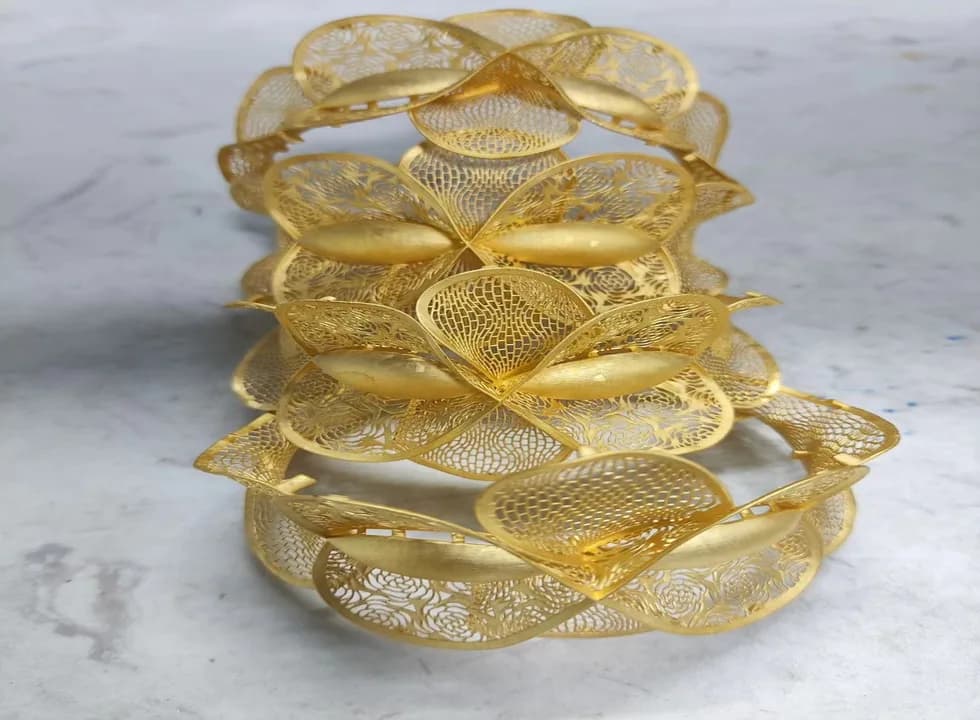
South Asia wedding seasons are compressed, high-variance production windows. A single client order can demand 20 to 60 coordinated pieces delivered inside a six-to-eight-week window: matched necklace sets, bangle stacks, hair accents, rings, and filler pieces. Demand skews toward openwork filigree — wire-drawn mesh panels, floral rosettes, pierced bangle bodies, and high-density surface detail that must survive casting, polish, and final setting without losing line sharpness.

The customer workshop profiled here serves jewelry retailers across India, the Gulf, and Southeast Asia. Their buyers specify openwork and filigree as the dominant aesthetic, and their production window gives them no room for re-runs. This is a baseline reality check on what the workshop had to ship, at what pace, with what tolerance for defects.

What Usually Goes Wrong

  • A single machine is asked to cover both ultra-fine filigree and broader geometry. The same vacuum-pressure profile that works on a 40 mm bow pendant will under-fill a 70 mm rosette necklace panel, and vice versa.
  • Filigree wire diameters below 0.5 mm start failing in short fills — missed details show up as broken petal edges, missing mesh nodes, and stone-seat walls too thin to hold pavé.
  • Production lots get mixed. Openwork bangle stacks and smaller filler pieces go into the same flask, so a single anomaly contaminates a whole lot, not just one geometry family.
  • Operator hand-offs drift. When a lead operator leaves mid-shift, pressure and burnout timing slip with them, and the next shift inherits an invisible process drift.

The Strategy: Two Chambers, Two Geometry Families

Instead of forcing one machine to handle every geometry, the workshop split the casting floor in two:

  1. CXM-C18 — dedicated to filigree and high-detail openwork. Tight, repeatable vacuum draw and a pressure profile tuned for wire widths of 0.4–0.7 mm. Used exclusively for the panel-heavy necklace sets, floral rosette statement pieces, bow and ribbon accents, and any component with mesh-pattern interiors.
  2. CXM-C20 — everything wider, heavier, or solid-backed. Vacuum + pressure + vibration in one chamber, 50 stored recipes, 242 cc crucible. Used for pavé-ready openwork cuffs, stacked bangle bodies with solid rims, large pendant shells, and the occasional custom showcase piece (including the workshop's gold-plated pavé football display, reported separately).

The pairing runs in parallel, not sequentially. Flasks enter each line routed by geometry class, not by arrival order. This is the single most consequential operational change: routing happens at flask preparation, not at the casting chamber.

Result: What Shipped

Across a six-week wedding-season window, the workshop shipped:

Geometry FamilyPieces (approx.)MachineNotes
Matched necklace + earring + ring sets (floral rosette)8 setsCXM-C18Full openwork panels, 0.5 mm filigree
Paired necklace sets (leaf + flower motif)6 setsCXM-C18Two pair symmetry across pieces
Bow and ribbon pendants / hair accents12+ piecesCXM-C18Ran in one batched flask family
Openwork bangles (three-cuff variants)9 piecesCXM-C20Wider body, pressure-assisted fill
Stacked bangle sets (sunburst, geometric, lattice)6+ stacksCXM-C20Production batches of 4–6 per stack
Mixed rings, hair pins, filler pieces10+ piecesCXM-C18Packed into filigree flask residuals

First-pass yield across the season landed above 90% on the filigree line and above 94% on the C20. Defect pattern was dominated by thin-to-thick junction pits at filigree-to-solid transitions — a known pattern solved by lengthening the vacuum dwell on that specific flask family rather than touching pressure timing.

Operational Guardrails

Three rules kept the season predictable:

  • Route at flask prep, not at casting. Geometry-class tags are applied to each flask before it reaches either machine. Operators never decide routing at the chamber.
  • Separate shift-start lots from mid-shift lots. The first two flasks of a shift carry warm-up variance on both machines. They are marked and retained for internal audit, not shipped without extra QC inspection.
  • Lock one recipe per geometry family per week. Parameter drift over a long production window is more destructive than any single bad flask. The workshop froze recipe variants weekly and tuned only between weeks.

Replication: What Other Workshops Can Take From This

This case generalizes to any workshop running South Asia, Gulf, or Southeast Asia wedding volume. The core takeaways:

  1. Treat filigree and heavy-geometry casting as different physical processes, not different settings on the same machine. If you can afford two chambers, assign them by geometry class.
  2. If you only have one chamber, at minimum separate flasks by geometry class and run them in consecutive blocks with recipe resets between blocks — not interleaved.
  3. Move casting-line decisions upstream. The cheapest time to correct a flask is at preparation. The most expensive time is after the pour.
  4. Track defects by geometry-family × shift rather than by total piece count. A 6% defect rate looks fine as an aggregate and disastrous when it's concentrated in one family.

Practical FAQ

Can a CXM-C20 alone handle all this, without a C18?

For smaller-volume workshops, yes — the C20's vibration plus pressure-assisted fill covers a wider geometry range than a pure pressure machine. But at wedding-season scale with heavy filigree content, running a C18 in parallel removes the bottleneck and protects first-pass yield on the highest-risk pieces. The cost of a parallel line is recovered quickly when rework drops.

What wire diameters survive cleanly on the CXM-C18?

The workshop reports reliable fills down to 0.4 mm on single-span wires and down to 0.5 mm on connected mesh. Below that, expect to redesign the pattern rather than chase a fill.

How is burnout staged between two parallel lines?

The workshop uses one burnout oven feeding both machines, with flask ordering controlled by a single gate operator. Filigree flasks pull first after burnout (to minimize time-at-temperature variability), heavy-geometry flasks second. No routing happens at the pour station itself.

What about pavé-ready casting?

Openwork cuffs and bangle bodies intended for pavé setting run on the C20. The surface finish off the C20 holds pavé seat walls cleanly at 0.9 mm wall thickness, which is the workshop's minimum. Thinner walls move to the C18.

Is this repeatable season after season?

Yes — the binding constraint is operator training on the routing rule and recipe-lock discipline. The equipment does not drift; the process does. Workshops that institutionalize routing before casting, and recipe lock between weeks, repeat these yield numbers without additional capex.