Choosing a vacuum pressure casting machine is rarely about the feature list. The decision starts with the defects you keep seeing on your shop floor — and ends with the part of the machine your operators will actually use eight hours a day.
Jewelry workshops moving from manual centrifugal casting to automated vacuum-pressure systems usually arrive with the same question: which model fits our production? The honest answer is that the model matters less than how the machine slots into your existing workflow. The framework below is drawn from two decades of installations across India, Saudi Arabia, Turkey, Indonesia, and the Philippines.
Start With the Defects You Keep Seeing
Before reading any spec sheet, write down the three most common defects in your last ninety days of casting: cold-shut lines, surface porosity, pinhole freckles, segregation, incomplete fill of fine filigree details. Each defect points to a different equipment lever.
Cold-shut lines and incomplete fill are pressure-curve problems — they reward machines with controllable pressure profiles after vacuum, not just on/off pressurization. Surface porosity and pinholes correlate with vacuum quality and degassing time. Segregation in mixed-metal alloys (gold-silver, gold-platinum) points to crucible turbulence and benefits from secondary vibration applied during pouring.
If your defect ledger is dominated by porosity and pinholes, a quality vacuum-only machine may serve you better than a feature-heavy hybrid. If it is dominated by fill failures and segregation, that is where vacuum-pressure-vibration combined units like the CXM-C20 earn their keep.
Single-Pour Weight Drives Crucible Capacity
Spec sheets quote crucible capacity in cubic centimeters, but the practical constraint is the maximum mass of metal you will pour in a single shot for your largest piece. A 242 cc crucible holds roughly 4.6 kg of 14k gold or 3.2 kg of sterling silver — adequate for studio work and most workshop output, but tight for large bangle batches and bullion-scale runs.
The trap is over-sizing. A one-kilogram-class crucible does not run efficiently with two hundred grams of metal, and operators end up topping off with fresh stock to make the thermal mass behave. Pick the smallest crucible that comfortably handles your top-decile pour weight, then size up only if your product roadmap is concretely heading there in the next twelve months.
Vacuum, Pressure, and Vibration — What Each Layer Buys You
Three independent functions get bundled in modern hybrid units, and it helps to read each one separately.
Vacuum removes dissolved gas from the molten metal and from the investment cavity. A working vacuum below 10 hPa is the threshold below which gas porosity drops noticeably; below 1 hPa is industrial-grade. Vacuum is what protects fine filigree from looking matte and pitted on the finished surface.
Pressure applied after pouring forces metal into thin sections faster than gravity alone. The shift from gravity casting to vacuum-pressure casting is usually where workshops first see consistent fill of 0.4 mm prongs and openwork details. The number to look for is not peak pressure but how quickly the machine reaches it after the pour begins.
Vibration applied during the pressurization phase refines grain structure and helps mixed-metal alloys homogenize before solidification. It is the most specialized of the three and matters most for thicker geometry — bullion bars, signet rings, large bangles — where solidification gradients drive segregation.
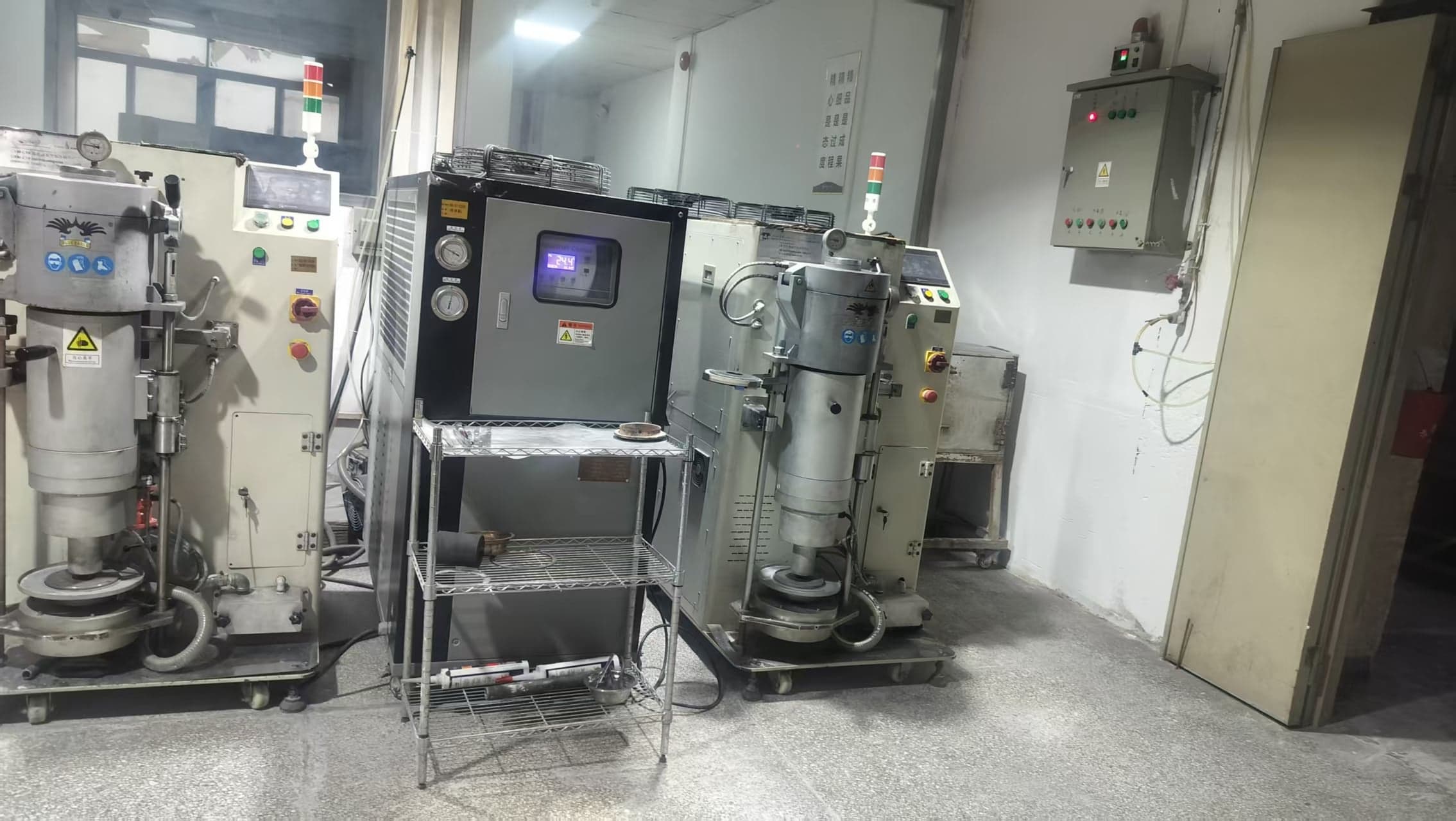
Whether you need all three depends on what you cast. A workshop running mostly chains and stamped findings rarely needs vibration. A workshop targeting large showcase pieces — gold-ball pavé, hollow Cuban necklaces, filigree wedding sets — usually does. The CXM-C18 paired with the CXM-C20 seen in several South Asia workshops puts the vacuum-pressure unit in line for daily production and reserves the vibration-equipped machine for the difficult geometries.
Temperature Range Matters Less Than Control Discipline
Most jewelry casting operates well below the 1450 °C ceiling that hybrid machines advertise. K-type thermocouples covering up to 1200 °C handle 24k gold (1064 °C), 18k yellow (around 950 °C), sterling silver (893 °C), and platinum-bearing alloys with margin. R-type extensions up to 1450 °C are needed only for pure platinum work and certain high-temperature master alloys.
What matters more than peak temperature is the precision and repeatability of holding it. The same workshop running the same alloy on the same machine should land within ±2 °C across consecutive lots. That repeatability comes from PID tuning, sensor placement, and crucible thermal mass — not from a higher ceiling on the spec sheet.
A useful question to ask any vendor: what is the standard deviation of pour temperature across one hundred consecutive shots, holding alloy and program constant? Vendors who cannot answer that question concretely have not measured it.
One Flagship Versus a Multi-Machine Line
Workshops below roughly thirty kilograms per month of finished output usually do well with a single hybrid unit. Above that, a two-machine line outperforms a single flagship for the same total spend.
The argument is throughput continuity. A single flagship is idle while one tree finishes its solidification cycle; a paired line keeps one machine pouring while the other completes its cycle. The CXM-C18 and CXM-C20 pair seen in Indian and South Asian workshops handles roughly sixty kilograms per month of mixed 18k product. A single CXM-C20 in the same workshop tops out around thirty-five kilograms before queue stacking starts losing daily lots.
Specialty geometries that justify their own line — the CXM-G4P4 for granulator-fed parallel casting, dedicated platinum centrifugal units for high-temperature work — sit beside the main line rather than replacing it.
Service and Spare Parts — Ask Before You Buy
The decision people regret most often is buying the cheaper unit from a vendor without a service network in their region. Casting machines run hot, dirty cycles every working day. Crucibles wear out. Pressure seals fatigue. Thermocouples drift. Vacuum pumps require periodic rebuilds.
Before any quote becomes a purchase order, get specific answers to three questions: what is the typical lead time for a replacement crucible to your address; which parts are stocked in your region versus shipped from origin; what is the documented response time for a remote diagnostic call. The answers should be written into the offer, not implied.
What This Looks Like in Practice
A workshop in Mumbai casting 18k gold filigree wedding sets with weekly pour weights of two to four kilograms typically lands on a pressure-vibration hybrid like the CXM-C20 paired with a CXM-C18 for high-volume parallel work. A platinum-only studio in Bangkok working at maximum eight-hundred-gram pours runs better on a smaller centrifugal unit with R-type sensors. A bullion shop in Dubai pouring twenty-kilogram gold bars in a single shot needs a dedicated bullion line, not a jewelry-class hybrid.
The machine does not make the product; the workflow does. The right choice is the one that lets your operators settle into a rhythm with fewer adjustments per shift, not the one with the most checkboxes on the spec sheet.
If you would like a configured comparison against your specific output mix, our sales engineering team will scope it within twelve hours. Tell us about your line and we will come back with a written recommendation, not a generic catalog excerpt.