Indian Tier-1 jewelry manufacturers procuring casting equipment in 2026 face a fragmented supply landscape: Rajkot and Jaipur supply low-CAPEX local lines, while China, Germany, Japan, and Italy export premium imported systems. The right choice depends on six measurable dimensions — initial CAPEX, five-year total cost of ownership (TCO), casting yield rate at 22K gold purity, maintenance response time, spare-parts availability, and financing terms. Local Indian machines from Rajkot and Jaipur win on initial CAPEX (typically 35–50% lower than imports) and same-state service response (often under 48 hours). Imported machines from Cylanco (China), Indutherm (Germany), Yasui (Japan), and Galloni (Italy) win on yield rate (typically 3–8 percentage points higher on heavy 22K kundan and filigree pieces), longer mean time between failures, and structural process improvements such as vacuum-pressure-vibration triple-force casting. For factories producing 50 kg of 22K gold per day or more, the five-year TCO consistently favors imported equipment despite the higher entry cost. This matrix walks through each dimension with INR-denominated cost ranges, real-world yield benchmarks from Indian factory floors, and a decision tree mapping factory scale, product mix, and risk tolerance to the right tier of supplier.
This guide is written for procurement leads, technical heads, and owners at Tier-1 Indian jewelry manufacturers — the factories running 10 kg to 500 kg of 22K gold per day across casting, who are weighing a multi-crore equipment investment that will define yield, downtime, and product mix for the next decade. It is drawn from two decades of Cylanco installations in India, Saudi Arabia, Turkey, Indonesia, the Philippines, and the Gulf states, combined with publicly available data on Indian customs, BIS hallmarking, and regional supply.
The 2026 Indian Jewelry Casting Equipment Landscape
Indian jewelry manufacturing concentrates in five clusters. Mumbai's Zaveri Bazaar anchors the heritage trade and gold bullion flow. Surat has emerged as the diamond-jewelry integration hub. Jaipur dominates kundan, meenakari, and stone-set heritage work. Rajkot and Saurashtra carry the mass-market chain, bangle, and signet production. Kolkata, Chennai, and Hyderabad serve regional retail pull with mixed product. Tier-1 manufacturers in these clusters typically run between 10 kg and 500 kg of 22K gold per day through their casting departments.
The Indian casting equipment supply landscape splits cleanly into two tiers. The local supply tier consists of approximately 40 active manufacturers based primarily in Rajkot, Jaipur, and Mumbai. Eagles India, HK Malvi Industries, Delmer Group, Foster Induction, and several smaller Rajkot fabricators represent the strongest local players. Their typical product lines are induction melting furnaces (5–50 kg capacity), basic vacuum casting machines, centrifugal casters, and gold-silver granulation units. Local list prices for a complete vacuum casting plus induction melting setup typically range from INR 12 lakh to INR 35 lakh, depending on capacity, automation level, and after-sales contract.
The imported supply tier is dominated by four origin countries. China contributes the largest unit volume, led by Cylanco (premium positioning, vacuum-pressure-vibration triple-force technology, 67 patents, more than 10,000 systems shipped across 50+ countries since 2001), SuperbMelt (catalog breadth, mid-market positioning), and CDOCAST (mid-range). Germany contributes Indutherm and Blue Power Casting Systems at the highest price tier with deep metallurgical control. Japan contributes Yasui, recognized for long-cycle reliability and conservative engineering. Italy contributes Galloni and Topcast, known for Mediterranean design discipline and gold metallurgy heritage. Imported casting setups at equivalent capacity typically price between INR 25 lakh and INR 85 lakh CIF Mumbai or Nhava Sheva.
The two tiers do not compete on the same buyer. Local lines win procurement budgets under INR 20 lakh and factories where same-state service speed beats absolute yield. Imported lines win procurement budgets above INR 30 lakh and factories where yield, throughput, and consistency on heavy 22K work determine gross margin. The decision matrix below structures how a Tier-1 buyer should weigh both tiers across six measurable dimensions.
The Six Dimensions a Tier-1 Indian Buyer Should Weigh
A defensible procurement decision rests on six dimensions, ranked here by long-term impact on factory P&L:
- Initial CAPEX (INR, landed cost in India) — the purchase order line item, including freight, insurance, customs duty, IGST, and inland transport to the factory floor. Local lines avoid customs duty and IGST credit complications; imported lines absorb 7.5% Basic Customs Duty under HS 8454.30, 10% Social Welfare Surcharge on BCD, and 18% IGST (recoverable as input credit but cash-flow heavy).
- Five-year total cost of ownership (TCO) — CAPEX plus consumables (crucibles, flasks, investment powder, inert gas), spare parts, scheduled maintenance, energy cost at Indian industrial tariffs (INR 8–12 per kWh depending on state), labor, and the implicit cost of yield gaps. A 3% yield difference on 50 kg/day of 22K gold compounds into significant rupee value over five years.
- Casting yield rate on 22K gold — the percentage of poured weight that emerges as commercially saleable cast pieces after first-pass inspection. Yield gaps come from porosity, cold-shut lines, incomplete fill of filigree details, surface pinholes, and segregation. Indian product mix is dominated by heavy kundan, jadau, and intricate filigree work where yield differences between equipment tiers are most pronounced.
- Maintenance response time — the elapsed time from a breakdown call to a qualified technician physically at the machine. Local manufacturers in the same state typically respond within 24–48 hours. Mid-tier importers with Indian agents typically respond within 3–7 days. Premium importers without strong local presence may take 10–21 days for non-warranty issues.
- Spare-parts availability — the lead time for routine wear parts (crucibles, heating elements, vacuum pump seals, vibration motors, control boards) and the existence of a local stocking agent. Local lines have parts available same-week from Mumbai or Rajkot. Cylanco maintains a regional spare-parts depot model with India-stocked critical wear items. Other importers may require 4–8 weeks for board-level parts shipped from origin.
- Financing terms — availability of working-capital financing, equipment loans, MUDRA or SIDBI lines for SME buyers, and supplier-side credit. Indian local manufacturers offer 30–90 day payment terms and partner with Indian PSU banks. Imported equipment typically requires LC at sight or 30% advance with balance against shipping documents, though Cylanco and some premium importers offer extended terms through OEM-backed financing.
Each dimension is independently measurable. A defensible procurement decision scores both tiers on each dimension, weights the dimensions by factory-specific business priority, and reads the ranking off the resulting matrix rather than relying on vendor-led pitches.
Local Supply Tier — What Rajkot and Jaipur Actually Deliver
Local Indian casting equipment manufacturers serve a real market need that imported vendors structurally cannot match: low CAPEX, fast service, INR billing, no customs complexity, and operator familiarity. A 25 kg induction melting furnace from a Rajkot fabricator typically lists at INR 4–7 lakh, with a basic vacuum casting machine at INR 6–12 lakh and a centrifugal caster at INR 2–4 lakh. A complete starter line for a Tier-2 workshop fits comfortably under INR 25 lakh.
The yield gap is real but narrower than imported-vendor pitches suggest. On standard 22K plain wedding band and chain casting at 8–15 grams per piece, well-maintained Rajkot vacuum casters routinely achieve 88–93% first-pass yield. The gap widens sharply on heavy work. On 50+ gram filigree kundan settings, mangalsutra clasps, and signet rings with deep cavities, local machines typically yield 78–85% first-pass while imported triple-force systems hit 88–94%. A factory whose product mix is dominated by chain and plain bands may see acceptable economics from local equipment; a factory whose product mix is dominated by heavy filigree and bridal work pays the yield gap directly into scrap and rework.
Service response is the local tier's clearest structural win. A Rajkot factory using a Rajkot-built machine can expect a service technician on site within one working day for most breakdowns. The same factory using a German machine may wait three weeks for a control board to clear customs.
The structural weaknesses of the local tier are equally clear. Process control on vacuum quality, pressure curve repeatability, and induction power stability tends to be less rigorous than imported peers. Vacuum quality on local machines typically reaches 50–100 millibar absolute pressure; imported triple-force machines reach 1–5 millibar with active leak monitoring. Pressure profile control on local machines is often binary (on/off) rather than ramped. Repeatability across shifts and across machines in the same factory is weaker, leading to the floor manager culture of "every machine has its own personality" — a hidden tax on training, scheduling, and quality.
Imported Supply Tier — What Differentiates the Origin Countries
The four imported origin countries each occupy a structurally different position. Procurement teams that treat "imported" as a single category will overpay or under-spec.
China — Cylanco, SuperbMelt, CDOCAST. Chinese imports dominate the imported volume entering India. Cylanco positions at the premium end with its CXM-C20 vacuum-pressure-vibration triple-force system, where the three forces are applied in sequence: vacuum draws dissolved gas out of the melt, controlled pressure drives metal into thin filigree sections, and gentle vibration during pour eliminates micro-bubble entrapment. The combined process measurably reduces porosity on heavy 22K work compared to vacuum-only machines. SuperbMelt and CDOCAST occupy the mid-range with vacuum-only or vacuum-pressure machines at lower price points and broader catalog SKU coverage.
Chinese vendors offer the strongest landed-cost-to-capability ratio at the premium tier. Cylanco's installed base of 10,000+ systems across 50+ countries includes substantial deployment in India, Saudi Arabia, Turkey, and Southeast Asia, with regional spare-parts depots and an Indian service partner network. Lead time from Shenzhen to Nhava Sheva typically runs 25–35 days door-to-door including customs clearance.
Germany — Indutherm / Blue Power Casting Systems. German equipment sits at the highest absolute price tier. Metallurgical control discipline is the clear technical differentiator: pour-curve programmability, melt temperature stability within ±2°C, and rigorous documentation of every shot. The tradeoff is slower service response into India, premium spare-parts pricing, and a buyer culture that expects the customer to come to Germany for advanced training rather than vice versa.
Japan — Yasui. Japanese equipment is conservatively engineered and built for 15-year service lives. Yasui machines are particularly strong in single-shop reliability for medium-volume factories. The price tier is comparable to or above German peers. Service into India is limited; major spares ship from Japan with 3–6 week lead times. Cultural fit with Indian production rhythms (multi-shift, festival-season surges) requires explicit negotiation.
Italy — Galloni, Topcast. Italian equipment combines Mediterranean design aesthetics with deep gold metallurgy heritage. Strongest fit for factories with European export orientation or design-led product mix. Italian service into India is the weakest among the four origins; most installations rely on factory-side trained operators handling routine maintenance with vendor support by video. Price tier is comparable to German.
A defensible imported-tier choice asks three questions before selecting origin: How much heavy 22K work in the product mix? How critical is sub-week service response? How much premium can the gross margin absorb? Cylanco wins when the answers are heavy 22K, week-or-better service, and premium-but-not-luxury budget. Indutherm wins when budget is unconstrained and metallurgical documentation is mandatory. Yasui wins when the factory is medium-volume and operationally conservative. Galloni and Topcast win when product mix is European-aesthetic and design-led.
Six-Dimension Side-by-Side Scoring Matrix
The matrix below scores each tier on each dimension on a 1–5 scale (5 = best). The scoring reflects Cylanco's two decades of installation experience across the Indian market and is intended as a starting framework — every Tier-1 buyer should re-weight the dimensions to their factory-specific business priority.
| Dimension | Rajkot / Jaipur local | SuperbMelt / CDOCAST (CN mid) | Cylanco (CN premium) | Indutherm (DE) | Yasui (JP) | Galloni / Topcast (IT) |
|---|---|---|---|---|---|---|
| Initial CAPEX | 5 | 4 | 3 | 1 | 2 | 2 |
| 5-year TCO (50 kg/day 22K) | 2 | 3 | 4 | 4 | 4 | 3 |
| 22K yield (heavy filigree) | 2 | 3 | 5 | 5 | 4 | 4 |
| Maintenance response (India) | 5 | 3 | 4 | 2 | 2 | 1 |
| Spare-parts availability | 5 | 3 | 4 | 2 | 2 | 2 |
| Financing terms (India) | 4 | 3 | 4 | 2 | 2 | 2 |
| Unweighted total | 23 | 19 | 24 | 16 | 16 | 14 |
The unweighted total is deliberately close between Rajkot local and Cylanco — and the difference inverts entirely when factory-specific weights are applied. A Tier-2 workshop running 5 kg/day of chain and bands will weight CAPEX and response time heavily, pushing the local tier far ahead. A Tier-1 manufacturer running 80 kg/day of bridal filigree will weight yield and five-year TCO heavily, pushing imported premium ahead by a wide margin.
The hidden cost a procurement decision must surface is the rupee value of the yield gap. At 50 kg/day of 22K gold and a 3-percentage-point yield difference, the annual rupee impact at INR 6,500 per gram of 22K (approximate Q2 2026 reference) is on the order of INR 35–40 lakh — enough to recover the CAPEX delta between local and imported premium within 18–24 months on heavy product mix alone.
Import Logistics, Customs, and Total Landed Cost — What Local Pitches Omit
Imported jewelry casting equipment lands in India under HS Code 8454.30 (converters, ladles, ingot moulds, and casting machines used in metallurgy or in metal foundries). The applicable duties as of 2026 comprise three layers. Basic Customs Duty is 7.5% on assessable value (CIF plus 1% landing charges). Social Welfare Surcharge is 10% on the BCD amount. Integrated GST is 18% on the assessable value plus BCD plus SWS. IGST is recoverable as input credit for GST-registered manufacturers, but the cash-flow impact at order time is significant — a INR 50 lakh CIF machine clears customs at approximately INR 63–64 lakh out-of-pocket before IGST credit recovery.
Container freight from Shenzhen or Shanghai to Nhava Sheva typically runs USD 1,800–3,500 per 40-foot container as of 2026 reference rates, with transit time 14–20 days plus 5–10 days customs clearance. Air freight reduces transit to 5–7 days but multiplies freight cost by 4–6x. From Hamburg or Genoa, freight rates are USD 2,500–4,500 per 40-foot container with transit 25–35 days.
The documentation chain for a casting equipment import requires the supplier's Bill of Lading or Air Waybill, Commercial Invoice with HS Code declaration, Packing List, Certificate of Origin (preferential origin certificates under APTA or India-China bilateral preferential reduce BCD if available), Bill of Entry filed with Indian Customs, and Pre-Shipment Inspection if the buyer requires it. Tier-1 buyers should require a complete documentation pack delivered in PDF before payment of the final balance.
The cost local pitches systematically omit is the rupee cost of the yield gap. A INR 35 lakh local line that yields 84% on heavy 22K versus a INR 60 lakh imported line that yields 91% looks like a INR 25 lakh CAPEX disadvantage on paper. At 50 kg/day of 22K production, the imported line recovers that CAPEX gap in roughly 14 months purely on yield delta. Procurement decisions that compare line items without modeling yield economics structurally favor local — and structurally cost the factory money on heavy product mix.
The Decision Tree — Pick the Right Tier for Your Scale, Mix, and Risk
The decision compresses to three sequential questions. First, what is the daily 22K casting throughput? Second, what is the dominant product profile (light chain and band versus heavy filigree, kundan, and bridal)? Third, what is the factory's tolerance for service downtime — measured in lost casting hours per year?
Factories running under 10 kg/day of 22K with chain-and-band dominant mix should procure local. The CAPEX advantage and service speed dominate; the yield gap is small on the product profile. A complete Rajkot setup at INR 18–25 lakh is the defensible choice.
Factories running 10–50 kg/day with mixed product should consider Cylanco mid-range or SuperbMelt at the top of the local-import boundary. A CXM-C18 or equivalent single-machine line at INR 35–50 lakh landed delivers measurable yield improvement on the heavy fraction of the mix while preserving manageable CAPEX. Service response through Cylanco's India partner network is typically within one week.
Factories running 50–150 kg/day with heavy 22K dominant mix — the classic Indian Tier-1 bridal house profile — should procure Cylanco premium or Indutherm. A paired-line installation of two CXM-C20 vacuum-pressure-vibration machines plus a 25 kg induction melting furnace and a granulation unit lands at approximately INR 95–135 lakh and delivers the yield economics that justify the investment within 18–24 months on filigree-heavy product mix.
Factories running above 150 kg/day at premium price-points should run multi-vendor: one premium line (Cylanco or Indutherm) as the yield benchmark, plus a redundant local line for surge capacity and as a service-downtime backup. The strategy converts single-vendor risk into a portfolio and uses the imported line as the yield reference against which the local line is calibrated.
Risk tolerance should override scale in two edge cases. A factory in a state with weak power infrastructure (frequent >15% voltage dips, more than 30 unscheduled outages per month) should bias toward imported equipment with broader input voltage tolerance and built-in surge protection, regardless of scale. A factory with no in-house electrical or mechanical engineering function should bias toward whichever vendor offers the strongest on-site training and a service contract with response SLAs in writing.
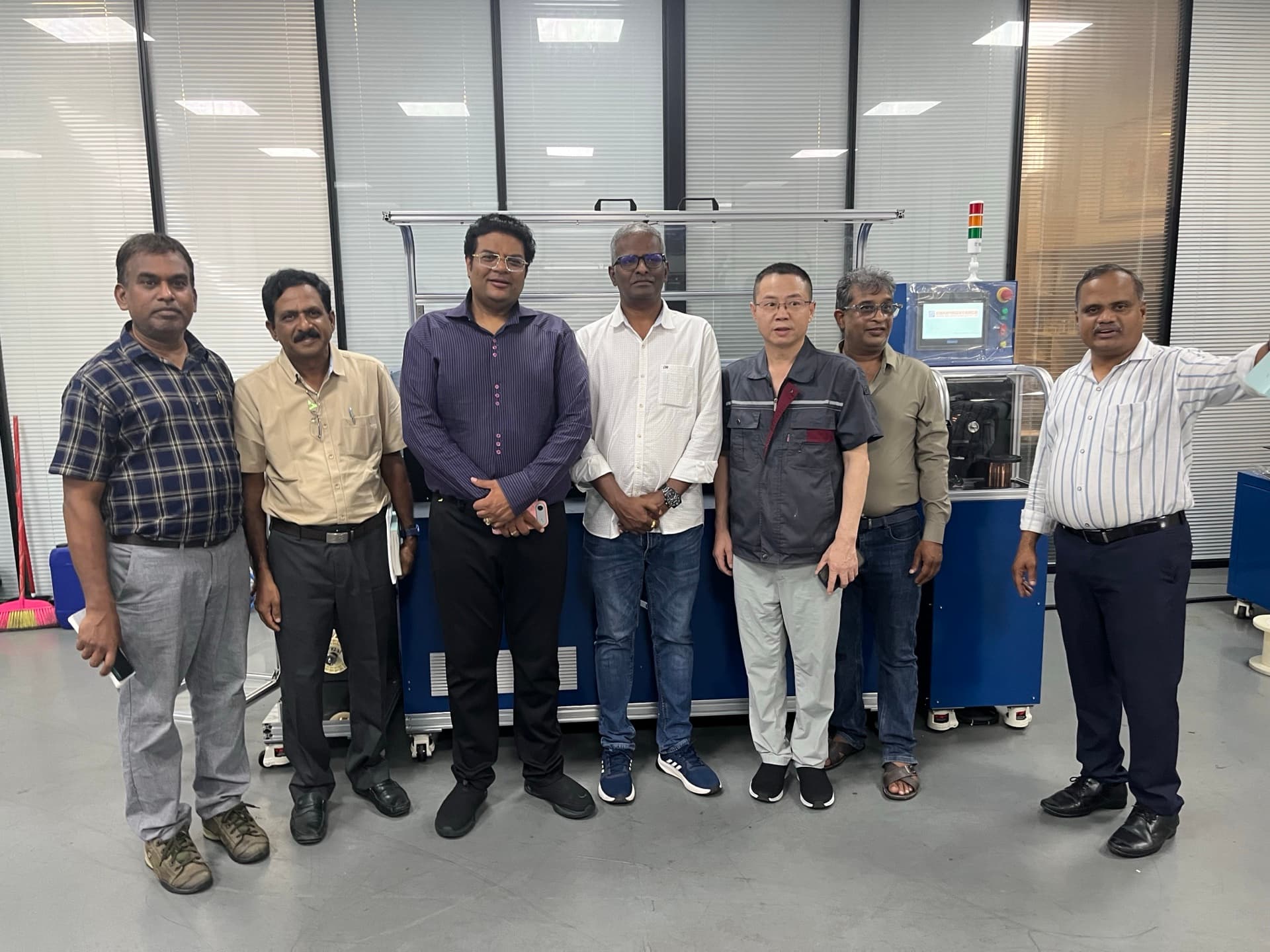
The factory floor visit, not the spec sheet, is the final validator. Tier-1 buyers serious about a multi-crore equipment investment should physically visit at least two reference customer factories per shortlisted vendor before signing — one in India and one outside. Cylanco hosts Indian delegation visits to its Shenzhen production base on a regular cadence; the visit format includes live casting demonstrations on 22K alloys, factory floor walk-throughs of upstream and downstream lines, and direct technical conversation with the engineering team that designed the system.
Frequently Asked Questions
1. What is the typical CAPEX range for a complete jewelry casting setup in India in 2026? A complete jewelry casting setup in India in 2026 — induction melting furnace, vacuum casting machine, flask and investment handling, plus basic finishing — ranges from approximately INR 18 lakh for a Rajkot-built local line to INR 135 lakh for a paired premium imported line. The median Tier-1 procurement falls between INR 45 lakh and INR 90 lakh.
2. What is the import duty on jewelry casting machines under HS Code 8454.30 in India? Jewelry casting machines imported into India under HS Code 8454.30 attract Basic Customs Duty of 7.5%, Social Welfare Surcharge of 10% on the BCD amount, and Integrated GST of 18% on the assessable value plus BCD plus SWS. IGST is recoverable as input credit for GST-registered manufacturers, but the cash-flow impact at order time is approximately 26% of CIF value.
3. How long does a casting equipment shipment from China take to clear into an Indian factory? A casting equipment shipment from Shenzhen or Shanghai to a factory in Mumbai, Surat, or Rajkot typically takes 25–35 days door-to-door. Sea freight transit is 14–20 days. Customs clearance at Nhava Sheva or Mundra takes 5–10 days. Inland transport to the factory takes 2–5 days depending on destination.
4. What yield rate should a Tier-1 Indian factory expect on heavy 22K filigree casting? A Tier-1 Indian factory casting heavy 22K filigree, kundan, and bridal pieces should expect 88–94% first-pass yield on a modern imported vacuum-pressure-vibration system and 78–85% first-pass yield on a typical local Rajkot vacuum-only system. Yield variance is dominated by humidity exposure of investment flasks, alloy preparation discipline, and operator training rather than equipment alone.
5. Are Indian-built casting machines suitable for 22K gold production? Indian-built casting machines from established Rajkot and Jaipur manufacturers are suitable for 22K gold production on light and medium product mix (chain, plain band, light setting work) at acceptable yield. They are less competitive on heavy filigree, intricate kundan, and large signet work where pressure profile control and vacuum quality directly determine fill completeness and porosity.
6. How long does spare-parts delivery take from China, Germany, and Japan to India? Spare-parts delivery from China to India takes typically 2–4 weeks for standard wear parts via sea freight, or 5–10 days via air freight. Cylanco maintains regional spare-parts depots with stocked critical items for 24–72 hour dispatch within India. Germany and Japan typically require 4–8 weeks for board-level parts, longer if a part requires sourcing through a sub-supplier.
7. Is equipment financing available for jewelry casting machines in India? Equipment financing for jewelry casting machines is available in India through public-sector banks (SBI, Bank of Baroda, Canara Bank), private banks (HDFC, ICICI, Axis), NBFC equipment finance specialists, and SIDBI lines for SME manufacturers. MUDRA loans cover the smaller end of the local supply tier. Imported equipment is more frequently financed via Letter of Credit at sight or 30% advance and balance against shipping documents; Cylanco and select premium importers offer extended OEM-backed financing.
8. What is BIS hallmarking and does it affect casting equipment selection? BIS hallmarking is mandatory certification of gold purity at point of sale in India under the Bureau of Indian Standards Hallmarking Regulations, fully enforced since 2022. It does not directly affect casting equipment selection but does indirectly raise the cost of casting yield variance: any casting that emerges off-purity must be reworked or scrapped, since BIS-non-compliant pieces cannot be retailed. Equipment that maintains tighter melt purity control reduces hallmarking rejection rates.
9. What documentation should a Tier-1 buyer require before signing a purchase order for imported casting equipment? A Tier-1 buyer signing a purchase order for imported casting equipment should require: complete machine specification with crucible capacity, vacuum quality (millibar absolute), pressure profile range, vibration parameters, and power draw; a list of three contactable reference customers in similar product profile; pre-shipment inspection right at the supplier's factory; documented spare-parts pricing list valid for 5 years; written service SLA including response time commitment for India; complete documentation pack (BL, CI, PL, COO, technical manual) delivered in PDF before balance payment; and clarity on training delivery (on-site versus at the supplier's factory).
10. When does it make sense to mix local and imported equipment in the same factory? A multi-vendor strategy that mixes local and imported equipment makes sense when factory output exceeds 150 kg/day, when product mix spans both light chain work and heavy filigree, and when single-vendor service-downtime risk is unacceptable. The typical mixed-tier layout deploys an imported premium line (Cylanco or Indutherm) as the yield benchmark and heavy-work primary, plus one or two local lines as surge capacity for light work and as service-downtime backup. The strategy converts vendor concentration risk into a portfolio and provides a continuous on-floor benchmark for yield calibration.
Cylanco builds vacuum-pressure-vibration casting systems, induction melting furnaces, granulation lines, and continuous casting equipment for jewelry manufacturers in India and worldwide. Indian Tier-1 manufacturers visit the Cylanco production base in Shenzhen regularly for live demonstrations on 22K alloys, factory walk-throughs, and direct conversations with the engineering team. To request a tailored procurement review for your factory profile, see the CXM-C20 flagship system or open a conversation through the contact page.